Houston – September 08, 2026 -- A Houston plastic surgeon is applying decades-old principles of classical sculpture to modern body-contouring procedures, arguing that anatomy and artistry must work together for safe, natural-looking results.
Dr. Emmanuel De La Cruz studies proportion and shadow before ever entering the operating room
Emmanuel De La Cruz, MD, founder of De La Cruz Plastic Surgery and a double board-certified plastic and reconstructive surgeon, says his years studying classical portrait and figurative sculpture shape how he approaches liposuction and body contouring. "Sculpture changed the way I see the human body," De La Cruz said. "You begin seeing how every contour flows into the next."
High-definition contouring is about proportion, not just fat volume, De La Cruz says
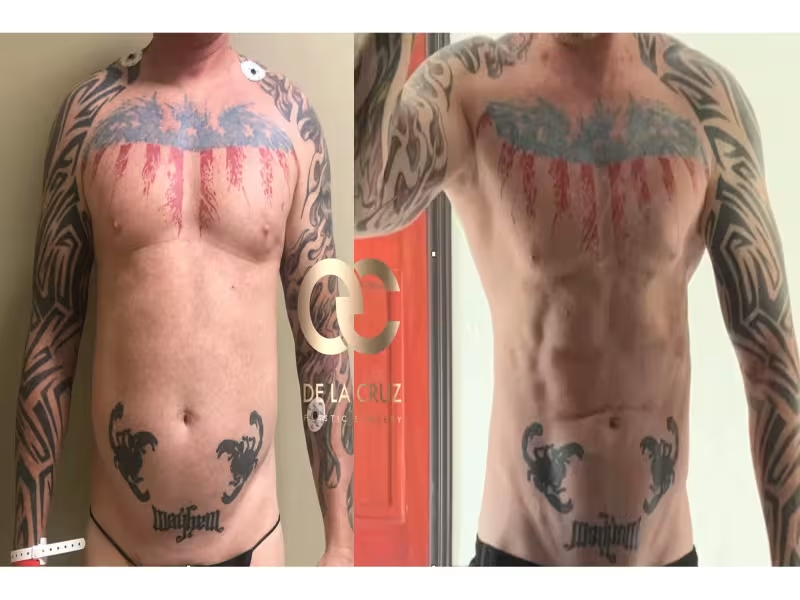
De La Cruz distinguishes between simple fat removal and true body sculpting, saying the goal is selectively modifying fat thickness while respecting underlying muscle anatomy. "A few millimeters in the right location can be more important aesthetically than removing another liter of fat," he said. His practice uses VASER-assisted liposuction, power-assisted liposuction and select energy-based technologies, though he maintains that devices cannot replace surgical judgment.
His peer-reviewed research addresses safety in large-volume liposuction
De La Cruz authored "Lipoplasty in the Overweight Patient," published in Clinics in Plastic Surgery, examining patient selection and perioperative factors in larger-volume procedures, including fluid management, hypothermia prevention, venous thromboembolism prophylaxis and postoperative monitoring. He argues that liposuction safety cannot be reduced to liters removed or hours in surgery. "You have to consider the patient, the magnitude of the operation, anesthesia, fluid management, temperature control, VTE prevention, the surgical facility and the level of postoperative monitoring together," he said, adding that surgical infrastructure should match the scale of the procedure.
De La Cruz rejects the idea of a single "signature" surgical look
Amid social-media trends that popularize specific silhouettes, De La Cruz says he tailors each operation to a patient's existing anatomy and goals rather than producing a uniform result. "I don't believe in giving everyone the same look," he said. "My responsibility is to understand what is already there and determine how surgery can enhance it—not erase their individuality."
He expects AI and imaging tools to expand what's possible, not replace anatomical expertise
As artificial intelligence and advanced imaging enter aesthetic medicine, De La Cruz says the field's next phase will still depend on understanding human form. "Plastic surgery is still an art grounded in anatomy," he said. "You need science to operate safely, technology to expand what is possible, and an artistic understanding of proportion to know when you've done enough."