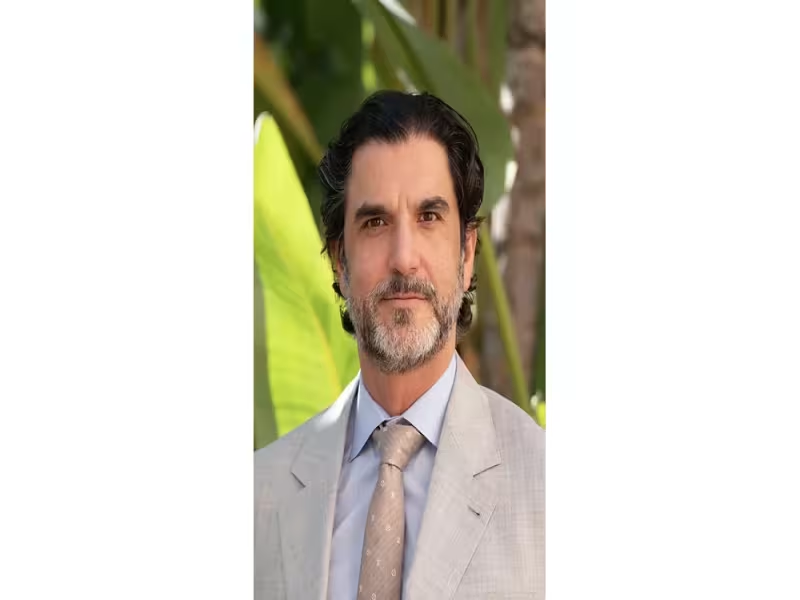
Beverly Hills – September 16, 2026 -- Patients who once sought bigger breast implants or more dramatic Brazilian butt lifts are increasingly asking surgeons to scale things back, according to board-certified plastic surgeon David Sayah, MD, FACS, who practices in Beverly Hills, California.
Dr. Sayah says breast implant removal, breast revision surgery and buttock reduction have become a regular part of his practice as patients seek to restore more natural proportions after earlier augmentation.
National implant removal numbers stay flat even as consultations shift
The American Society of Plastic Surgeons' 2024 Plastic Surgery Statistics Report recorded 41,271 breast implant removal procedures in 2024, compared with 41,115 in 2023 -- a marginal change. Dr. Sayah says the raw totals don't reflect what he's hearing in his own consultation room, where conversations have moved from adding volume to reducing or revising it.
Fat grafting offers an alternative to a second implant
For patients removing implants, Dr. Sayah says the surgery itself is often just one step. Years of augmentation can alter breast skin, soft tissue and shape, so additional procedures -- a breast lift, autologous fat grafting using the patient's own tissue, or a combination -- may be needed to restore position and proportion.
BBL reversal is becoming its own recognized procedure category
A similar pattern is emerging in body contouring. A 2025 study in Aesthetic Surgery Journal Open Forum reviewed 123 patients who underwent BBL revision or buttock reduction between 2018 and 2023, describing the procedures as an increasingly popular and growing segment of body contouring. Dr. Sayah still performs buttock augmentation but says the goal should be a result proportional to the patient's frame rather than augmentation for its own sake.
Surgeons say reversal can't fully undo years of added volume
Dr. Sayah cautions that revision surgery cannot simply recreate a patient's pre-augmentation appearance. Skin and soft tissue change after years of carrying extra volume, and the amount of retained fat from grafting varies by patient, meaning some people may need more than one procedure to reach their goal.
"The honest goal is proportion, not turning back the clock," Dr. Sayah said. "Revision surgery requires understanding what has changed anatomically and developing a realistic plan for restoring balance."