California – October 19, 2026 -- A retinal implant paired with camera-equipped glasses has helped more than 80% of recipients with advanced age-related macular degeneration (AMD) read, do crosswords, and use their phones after training. The PRIMA system was approved in Europe in July and is awaiting FDA clearance in the US.
PRIMA targets geographic atrophy, which affects more than 5 million people
Geographic atrophy is an advanced form of AMD in which retinal cells die off and leave a blind spot in the center of vision. Until now, no treatment could restore that lost sight. Science Corporation, based in California, developed PRIMA for these patients.
AMD does not destroy all retinal circuitry. Only the photoreceptors, the cells that convert light into electrical signals, die off. The implant mimics those cells and sends visual information to the healthy circuitry of the eye and on to the brain. Frank Brodie, an ophthalmologist at the University of California, San Francisco, and Science Corp.'s chief medical officer for ophthalmology, says the system leverages the body's own natural functions to process and transmit the information.
Glasses capture video at 30 frames per second
A miniature front-facing camera on the glasses records what the wearer sees in real time. The feed is roughly five megapixels at 30 frames per second, similar to TV. A fiber-optic cable carries the raw video to a small handheld processor that can sit on a table or go in a pocket.
A handheld processor turns video into infrared signals
The processor converts the video into infrared light signals and routes them back to the glasses. Physical buttons on the device let the wearer adjust contrast, brightness, and zoom.
A laser projector beams invisible light into the eye
A laser projector on the glasses faces the wearer and pulses near-infrared light at 880 nanometers, an invisible wavelength. The light passes through the pupil to the implant at the back of the eye.
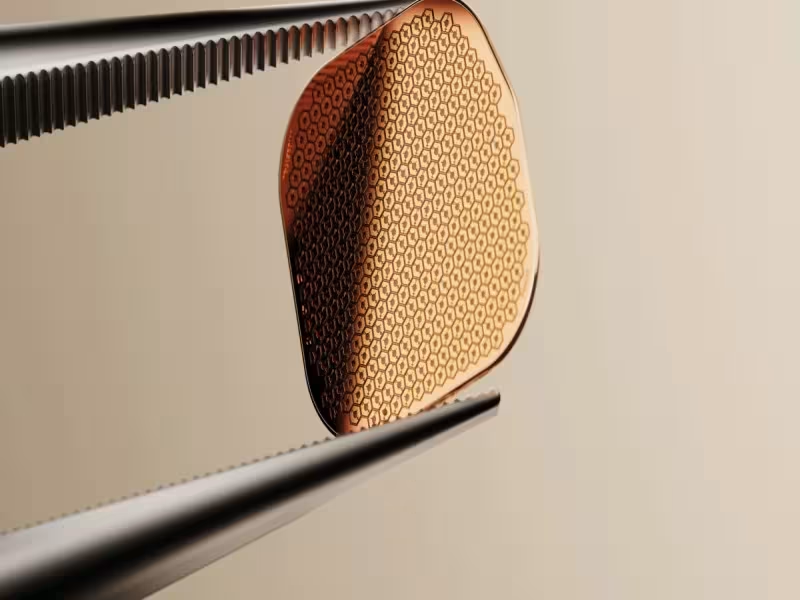
A 378-pixel chip powers itself from light
The implant has 378 pixels, each with an electrode and two photovoltaic cells. The cells convert light into a current that healthy bipolar and ganglion cells pass to the brain. They also work as solar cells that power the chip, so it needs no battery.