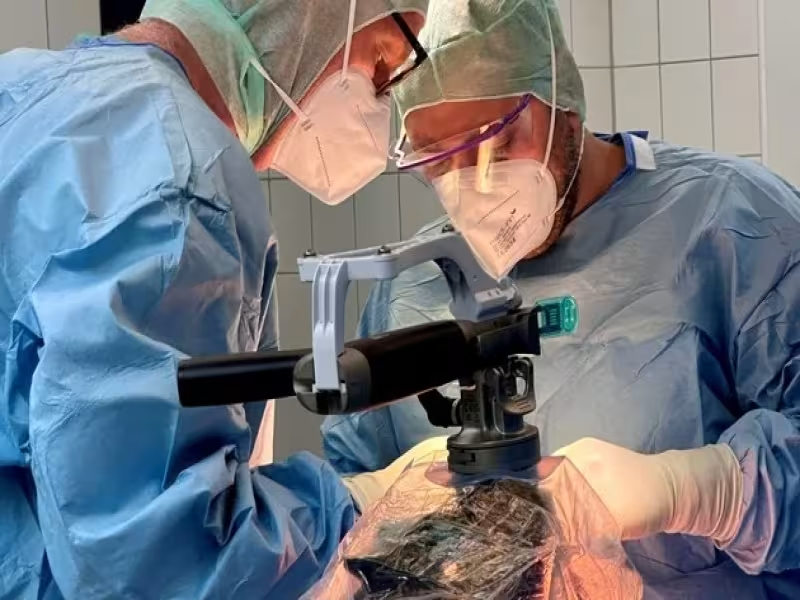
GIESSEN -- November 28, 2026 -- About 200 people a year receive a first artificial knee at the orthopaedics department of the UKGM university hospital in Giessen, and since September their surgeons have had a robot to help. The hospital says the robotic assistance system is the newest generation and is used in knee joint replacement.
The device first builds a 3-D model of the patient's knee. Surgeons use it to plan the position of the prosthesis and, according to clinic director Prof. Markus Rickert, to place it with millimetre accuracy. He says the robot allows precise cuts and fine corrections that were not possible before. The surgeon operating the robot stays in control.
The hospital says patients recover faster, but offers no figures
Rickert says the close fit to each patient's anatomy eases and shortens recovery after surgery. He also says patients report a surprisingly natural feeling in the new joint. These are the clinic's own early impressions, and no data on recovery times has been published.
The hospital recommends a new knee only when other conservative treatments, such as physiotherapy and pain therapy, no longer work. The main cause is advanced joint wear (arthrosis).
Giessen's 200 yearly cases are about 0.1% of German knee replacements
Germany sees roughly 180,000 first-time knee implants a year, according to the German Arthroplasty Registry (Endoprothesenregister Deutschland). By our calculation, Giessen's roughly 200 cases are about 0.1% of that total.
Rickert's team presents the method at a free event on 2 December
- Title: Roboter-assisted knee endoprosthetics ("Roboterassistierte Knieendoprothetik")
- Date: 2 December 2026, 17:00
- Place: main clinic building, UKGM Giessen, 4th floor, conference room KR 8 (4.151c)
- Registration: not required
The hospital has not said whether the robot is used for every knee replacement or only selected cases.