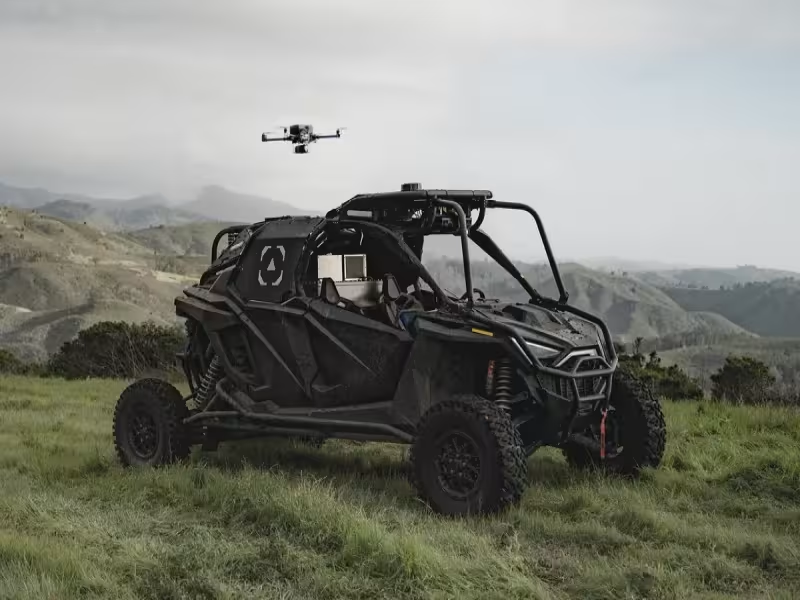
SHERIDAN, WYOMING – April 14, 2026 – A US defense technology company called Scout AI has developed what it describes as the first foundation model built specifically for multi-domain military robotics. The product, named FURY, is a vision-language-action (VLA) model that processes live camera feeds alongside voice or text commands to control unmanned systems in real time. Unlike conventional robot controllers that require specialist training or continuous network access, FURY is designed to interpret plain-language instructions and act on commander intent autonomously. The system is aimed at warfighters and defense operators who need robotic assets that can function with minimal oversight in contested, fast-moving environments.
What FURY Is and How It Works
A vision-language-action model merges visual perception, natural language understanding, and robotic output into a single AI system. FURY takes input from a camera—either standard RGB or thermal—alongside a text or voice prompt, then produces the specific movements and decisions for the robot to execute. Scout AI trained the model on a combination of human imitation data and simulation environments, enabling it to generalize across different platforms and mission types without requiring a full retraining cycle for each new use case. In practice, a warfighter could issue a command such as "fix enemy forces along route Tango" and the robot processes that intent, responds in natural language, and moves out independently.
Platform-Agnostic Design and Lean Hardware
FURY is built to run on any robotic form factor across all operational domains—ground vehicles, aerial systems, or others—without hardware lock-in. The model family is designed to accommodate different compute and power requirements, and all components are sourced from commercial off-the-shelf (COTS) parts. That approach supports high-rate, low-cost manufacturing while avoiding dependence on proprietary military supply chains. Crucially, the system can operate with as little as a single camera stream, removing the need for active sensors like LIDAR or radar—a deliberate design choice to cut power draw, reduce the sensor signature, and simplify field deployment.
FURY runs entirely at the edge, with no reliance on external cloud infrastructure or continuous connectivity. This is directly relevant for real-world operations where communications may be jammed or denied. The model supports secure over-the-air updates and on-device retraining, meaning units can adapt to new environments and threats without being withdrawn from the field for software maintenance.
Why it matters
Defense robotics has historically required either a dedicated human controller per unit or costly platform-specific software that doesn't transfer across systems. Scout AI's approach—training one generalized model on human behavior and simulation data—applies the same logic that reshaped consumer and enterprise software to military autonomous systems. Natural language robot-to-robot swarm coordination means a single operator could direct multiple autonomous assets simultaneously, with no specialized training required. That changes the human-to-robot ratio in the field and reduces the skill barrier for deployment. Passive vision-based sensing, edge inference, and plain-language command interfaces also make FURY viable in resource-constrained or communications-denied environments where competing architectures would fail.
Recent Milestones
Scout AI has moved from research into contracted deployment. In August 2025, the company was awarded a US Army UxS (Unmanned Systems) Autonomy Contract, a formal signal of military confidence in FURY's operational readiness. Days later, in September 2025, Scout AI announced a partnership with Hendrick Motorsports on a project called NOMAD, though the scope of that collaboration has not been detailed in public disclosures. The company is currently in an active hiring phase, with a stated goal of assembling engineers to advance what it calls the world's most important frontier in robotics.
As defense organizations accelerate investment in autonomous platforms, Scout AI's foundation model approach positions FURY as infrastructure-level technology rather than a single-purpose tool.