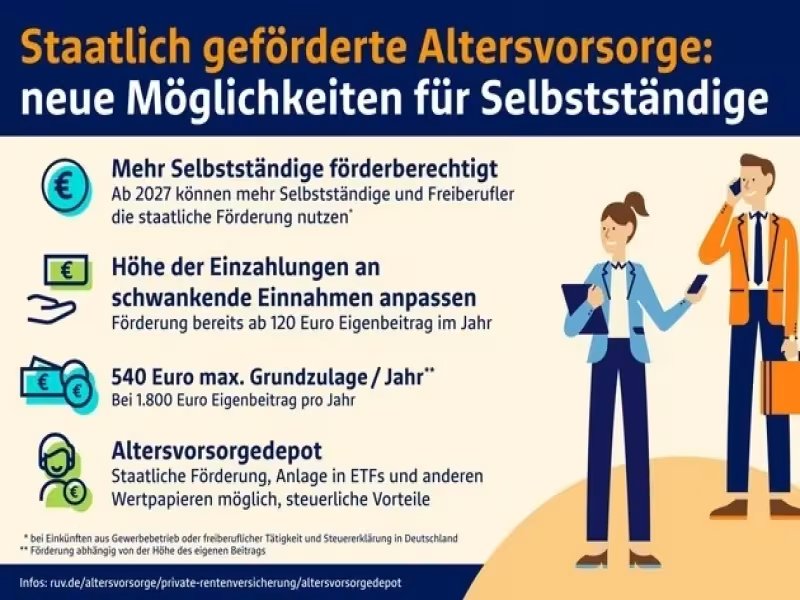
Wiesbaden – October 29, 2026 -- From 2027, many self-employed people in Germany can claim up to 540 euros a year in state subsidies for private retirement savings, including through the new Altersvorsorgedepot (retirement savings depot).
Eligibility covers self-employed people who pay compulsory contributions into the statutory pension insurance or who file an annual tax return. The earlier Riester subsidy was open to only a few self-employed people. Under the new rules, basically everyone with income from a trade or freelance work can be supported, provided they have filed their tax return for the contribution year.
The subsidy grows with your own contribution
The state pays 50 percent on the first 360 euros of your own annual contribution. On contributions above that, up to 1,800 euros, it adds another 25 percent. A contribution of 1,800 euros therefore earns the maximum basic subsidy of 540 euros per year. Child subsidies and tax benefits may come on top, depending on your situation.
Contributions can follow your income
The minimum to receive a subsidy is 120 euros a year. People with fluctuating earnings can pay in more in strong years and less in weak ones. A higher contribution raises the subsidy, up to the 1,800-euro cap.
R+V product manager Christian Kaiser says retirement planning often gets postponed in favor of the next project, and that starting early gives savings more time to grow.
Contracts with a guarantee or a depot without one
Contracts with a guarantee promise that 80 percent of paid-in contributions and subsidies is available when payouts begin. The Altersvorsorgedepot has no such guarantee, but money can go into funds, ETFs and other securities. Losses are possible. For beginners there is a standard depot with exactly two ETFs and legally capped effective costs of 1.0 percent at most.
Contributions up to 1,800 euros can cut your tax bill
Your own contributions of up to 1,800 euros a year, together with the subsidies, can count as special expenses under the legal conditions. The depot follows deferred taxation: deposits are tax-favored, while later payouts are subject to income tax.
Payouts start between ages 65 and 70
The savings are reserved for retirement. Regular payments begin at the 65th birthday at the earliest and before the 70th birthday at the latest. At the start of the payout phase, you can take up to 30 percent of the accumulated capital as a lump sum.