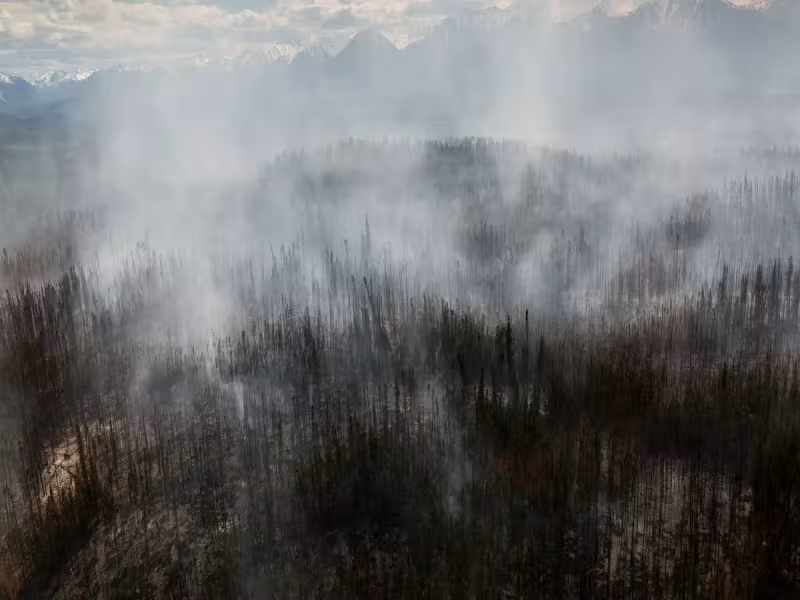
Fairbanks – October 19, 2026 -- Researchers in the US and Canada are studying whether detecting and putting out remote Arctic fires faster could keep permafrost carbon in the ground. Woodwell Climate Research Center, the University of Victoria's Polis Institute for Ecological Governance and the nonprofit Alaska Venture Fund are now partnering on a multimillion-dollar initiative called North Fire to study these interventions and raise public awareness of them.
A metal probe shows how fast thaw follows a fire
Near Fairbanks, scientists from the Alaska Fire Science Consortium used a T-shaped thaw probe at the site of the 2021 Yankovich Road Fire. Outside the burn scar, the probe hit frozen ground about a foot down. Where the fire had burned off the insulating moss and topsoil, it sank at least three times deeper.
Permafrost holds roughly twice the carbon of the atmosphere
Permafrost underlies 15% of the land in the Northern Hemisphere and stores around 1.5 trillion tons of carbon. Its footprint has shrunk about 12% since 1850. Fire emissions have risen 60% worldwide since 2001 but have nearly tripled across boreal forests. In 2023, Canadian wildfires released more carbon than the country's combined fossil fuel emissions.
A January study found that by 2100, fire-driven permafrost thaw could release the equivalent of nearly 80 billion tons of carbon dioxide under high-warming scenarios. General warming could release more than 400 billion additional tons over the same period.
Climate models still miss most permafrost loss
Only a minority of the models behind the UN's major climate reports include gradual permafrost loss, and none include the abrupt collapse that can follow fires. Brian Buma of the Environmental Defense Fund calls these emissions a "massive blind spot." He is developing tools to help fire agencies choose which fires to prioritize.
A 2022 study found fire suppression could be cost-effective
A 2022 Science Advances paper by researchers at Woodwell and the Union of Concerned Scientists found that putting out more boreal fires could cost the same as or less than building wind turbines, solar farms or carbon-removal factories. Woodwell's Brendan Rogers said, "We need to figure out a better way to live with wildfire."
The approach is controversial. Wildfire is a natural part of healthy forests, and covering huge unmanaged areas would take vast resources. Researchers also do not yet know how much emissions would fall. In Alaska, agencies are tasked with protecting life and property, and the general policy is to let remote fires burn unless they threaten communities.
The Yukon Flats refuge offered an early success
The Yukon Flats National Wildlife Refuge covers 11 million acres of wetlands, forests and bogs. Its foothills sit above yedoma, an especially deep, ice-rich and carbon-dense permafrost formed from wind-blown sediments frozen during the late Pleistocene.