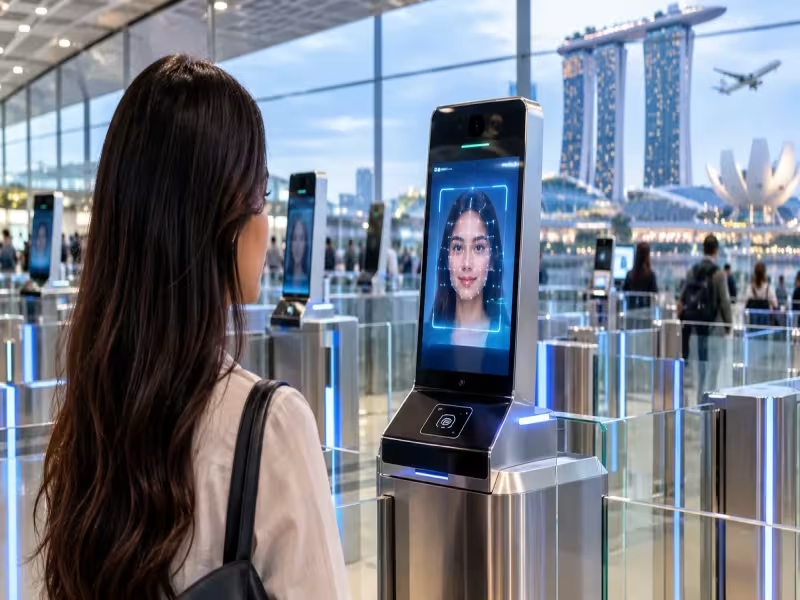
SINGAPORE -- November 24, 2026 -- A border check that averages close to ten seconds per passenger is the headline claim for Singapore's Changi Airport. A Travel And Tour World report on biometric border systems also covers Dubai, Japan and Estonia, but it gives no prices or launch dates.
Here is what each country is described as doing:
- Singapore: Changi uses facial and iris clearance lanes. The report says they remove physical document checks entirely.
- Dubai: Terminal 3 has smart corridors that use facial matching and AI iris scanning. The report says eligible travellers can pass immigration without showing a passport or boarding pass.
- Japan: Narita and Haneda use One ID face-recognition systems for boarding and baggage drop, and the rollout is expanding nationwide. Travellers register their face at an initial touchpoint or a self-check-in kiosk first.
- Estonia: It is piloting Schengen-wide digital travel credentials stored on a phone, backed by blockchain, rather than relying on airport cameras.
Changi's ten-second average works out to about 360 passengers an hour per lane
At ten seconds each, one lane would process six passengers a minute, or roughly 360 an hour, by our calculation. That assumes one person at a time and no gaps, and the report does not say how many lanes Changi runs.
Of the four countries, only Estonia is described as a pilot. Singapore, Dubai and Japan are described as deployed or expanding.
The report does not say which travellers qualify for Dubai's checkpoints, or when each system became or becomes available.
For official updates on Singapore's biometric framework, the report points readers to the Immigration & Checkpoints Authority of Singapore.