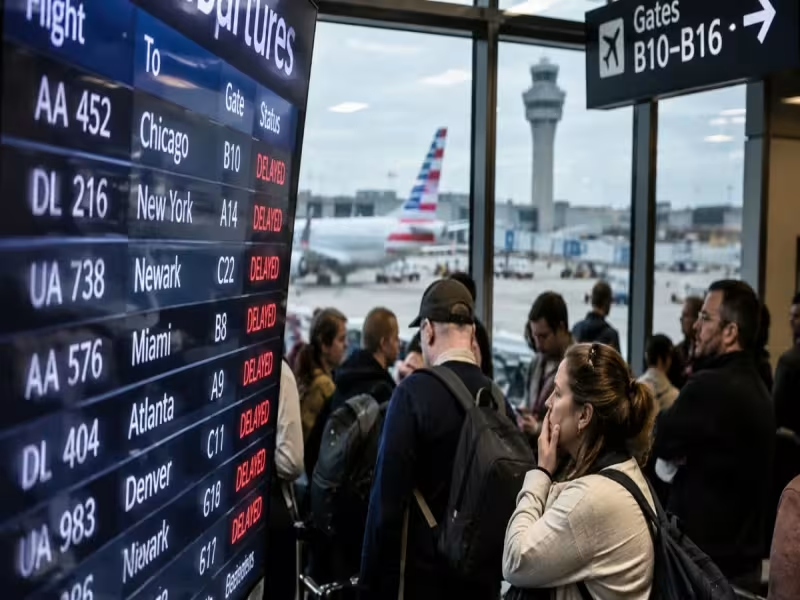
UNITED STATES -- November 19, 2026 -- Failing telecom equipment halted departures across the US for more than four hours on 13 November 2026. The Federal Aviation Administration (FAA) has since lifted the nationwide ground stop, but delays and rebooking problems did not end with it.
The FAA detected instability in radar and communications information at about 3:36 pm Eastern Time. Controllers restricted departures at US airports, while international arrivals were handled individually. The US Department of Transportation said the system suffered intermittent telecommunications failures, not a complete nationwide loss of radar or aircraft communications.
Overloaded switches and routers in older equipment caused the failure, officials say
Federal officials linked the disruption to overloaded switches and routers in older telecommunications infrastructure. Secretary Duffy said the equipment gave controllers inconsistent information, while newer internet-protocol switches already installed kept working. The FAA's findings are preliminary, and no completed technical investigation has been published.
For scale: according to FAA statistics, controllers handle an average of 44,360 flights a day. That works out to roughly 1,850 flights an hour, averaged over 24 hours.
US refund rules start at a three-hour delay on domestic trips and six on international ones
Under Department of Transportation refund rules, the conditions are:
- If an airline cancels your flight and you decline replacement travel or other compensation, you generally qualify for an airfare refund.
- A significant delay means arriving at least three hours late on a domestic itinerary, provided you choose not to travel.
- On an international itinerary, the threshold is six hours, twice the domestic figure.
Hotels, meals and extra compensation are not automatically guaranteed after an FAA system failure. Airline policies and the cause of each disruption decide that. Keep your booking records and contact the airline directly about connections and refunds.
Delays outlasted the reopening, and no verified total of cancellations exists
Aircraft and crews fly interconnected schedules, so one late departure can push back several later flights. The FAA's 14 November operations plan recorded airline-specific ground stops at Chicago O'Hare and New York LaGuardia. These were separate from the cancelled nationwide restriction.
The official releases reviewed gave no verified total for cancelled flights, affected passengers or economic damage.
The Transportation Secretary cited $12.5 billion in initial modernisation funding
The Transportation Secretary said more investment will be needed beyond that $12.5 billion. Separately, the FAA is rolling out its Enterprise Information Display System to replace older information-sharing technology. These upgrades are not repairs to the equipment involved in the November failure. The agency plans deployment across 435 sites by the end of 2028.