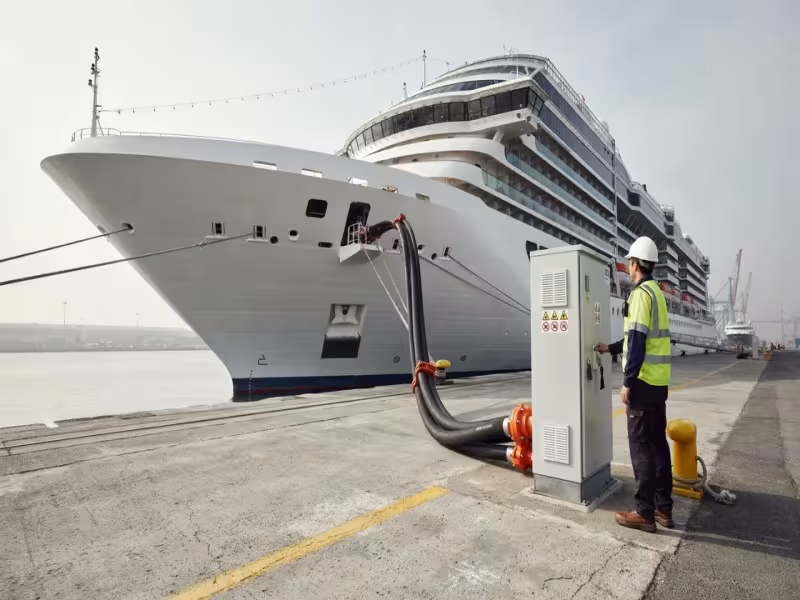
AMSTERDAM -- November 21, 2026 -- A sea cruise ship that cannot plug into the grid will lose its berth at Passenger Terminal Amsterdam in 41 days. Amsterdam's shore power rule takes effect on 1 January 2027, and the terminal authorities have confirmed that vessels without a certified connection cannot dock there.
Sea cruise ships without a certified connection lose access to the terminal from 1 January 2027.
The rule applies to one terminal, not the whole country. It is not a Netherlands-wide cruise ban, and official notices contain no general instruction to cancel bookings. The aim is to cut emissions and noise at berth: ships draw power from land for lighting, kitchens and other services, so they can switch off their generators.
The rule adds no visa, passport-validity or immigration requirements. If you have an Amsterdam call booked for 2027, the checks are about the ship and the berth:
- Ask whether your scheduled ship meets the terminal's requirements.
- Match transfers and assistance arrangements to the final terminal address.
- Recheck arrival and departure times, which are guidance and can change.
- Confirm the latest itinerary before departure.
Amsterdam's terminal has offered shore power since May 2025, with 2026 as a testing period.
The terminal can supply up to 16 MW to one sea cruise ship and has connections for eight river vessels. River ships must already connect. Sea cruise ships with suitable equipment are encouraged to connect during 2026, according to the terminal's published guidance.
Terminal equipment alone does not guarantee a ship can use it. Vessels need compatible electrical systems, enough power and workable connection procedures. The announcement does not say which ships hold a certified connection.
Revierkaia's cruise facility opened in September 2024, and Rotterdam's system followed in March 2025.
Copenhagen forecast 183 of 312 calls on shore power for 2026, but other ports set different rules.
Copenhagen's 2026 outlook puts connected calls at 183 out of 312, which works out to about 58.7%. That is roughly double the 88 connected calls it recorded in 2025 (183 divided by 88 is about 2.1). The outlook expects those calls to carry 79% of an estimated 880,000 passengers. Its five connection points share an initial 20 MVA, and the outlook plans 48 MVA for 2028, about 2.4 times as much.
Stockholm's November update forecasts 154 calls and 277,000 passengers for 2026, up 13% and 8% on 2025. Its infrastructure can serve at least 45% of calls, but its public-port status prevents a blanket connection requirement. Bergen publishes mandatory connection from 2026.
EU rules require ships to connect from 1 January 2030, three years after Amsterdam's deadline.
By 31 December 2029, qualifying EU ports must be able to supply at least 90% of relevant calls. For cruises, that covers ships above 5,000 gross tonnes at ports with more than 25 qualifying annual calls, averaged over three years. From 1 January 2030, covered passenger and container ships must connect at qualifying EU ports or use eligible zero-emission technology. Exemptions cover short stays, emergencies and certain connection difficulties.
Norway's national implementation of the wider maritime regulation will begin no earlier than 1 January 2028. That is an earliest possible date, not a confirmed start. The requirement extends to other equipped EU ports from 1 January 2035.