ANNAKA -- November 21, 2026 -- In 2025, 2,027 people walked a closed mountain railway in Gunma, and the Gunma Railway Walk has now won international recognition. Getting onto the tracks still works exactly as before.
Prefectural authorities announced on 29 October that the Gunma Abandoned Railway Walk at Usui Pass was selected for the 2026 Top 100 Stories. The municipality confirmed the selection on 11 November. The walk, in Annaka, takes visitors along railway tracks that are normally restricted.
The award adds no new access and no new entry rules
You still need to book an authorised departure and check its conditions. The announcement brings no unrestricted access, no passport concession, no visa waiver and no border procedure. Overseas visitors should check the requirements for their own nationality. The recognition covers one initiative, not the whole destination.
Routes run from about eight kilometres to a six-hour outing
Official visitor information describes routes of around eight or ten kilometres. A documented longer outing takes approximately six hours. These are examples, not fixed specifications. Government research also documents a shorter, one-hour experience and records demand for short visits among people interested in photography.
The local visitor office is near Yokokawa Station, but some itineraries start from the Karuizawa side. Pick your itinerary before you book onward rail. Expect dark tunnels, uneven ground and few toilet stops. Before booking:
- Confirm the departure date, meeting point, finishing location and availability.
- Check current charges, meal inclusions and equipment rental costs.
- Follow the stated helmet, light and footwear guidance.
- Ask about walking demands and accessibility needs.
Official tourism coverage mentions a Toge no Kamameshi rice meal. Verify whether your booking includes it. Abt Road, a separate public route of about 6.3 kilometres, has different access arrangements from the guided railway programme.
The 1893 line closed in 1997, and the walk reports 2,027 walkers in 2025
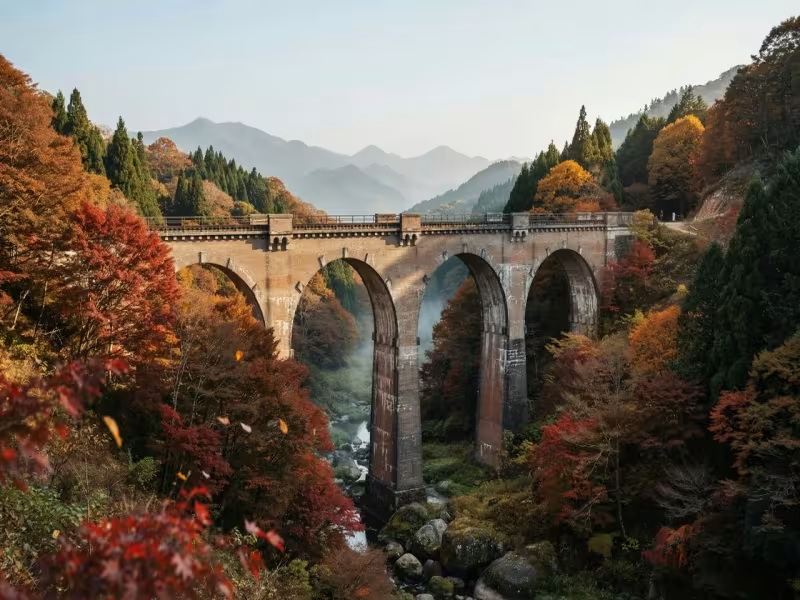
The railway between Yokokawa and Karuizawa opened in 1893. Official tourism records describe 11.2 kilometres with 26 tunnels, which works out to roughly one tunnel every 430 metres. Services across the pass ended in 1997, 29 years before this year's selection. The four-arch brick Usui Third Bridge, known as Megane-bashi, is 91.1 metres long and became a national Important Cultural Property on 17 August 1993. The walk itself began in 2018.
The programme's own submission reports 2,027 participants in 2025 and over 12,000 cumulatively. By our calculation, 2025 accounts for under 17% of that total. These are programme figures, not regional arrival statistics. No annual baseline accompanies them, so they show no growth rate. More than 120 registered supporters help with upkeep, and regular walks help spot fallen trees and slope failures.
The submission also reports that 80% of the local tourism organisation's independent revenue is contributed. That is not Annaka's total tourism income, and no accounting period is given.
Regional plans include a free stamp rally that does not cover the tour
Municipal records describe promotion to Taiwan and plans to strengthen itineraries linking Annaka, Tomioka and Karuizawa. Government research names stronger staffing, clearer safety information and better overseas booking arrangements as priorities. These are plans, not guaranteed extra departures.
An expert advisory group supports World Cultural Heritage recognition. The railway facilities are not on Japan's current cultural tentative list, a required stage before nomination, and no inscription date is confirmed.
A free Shin-etsu Line stamp rally runs from 14 November 2026 to 14 February 2027, about 92 days. It covers six stations and two other locations, and it does not include admission to the guided tour.