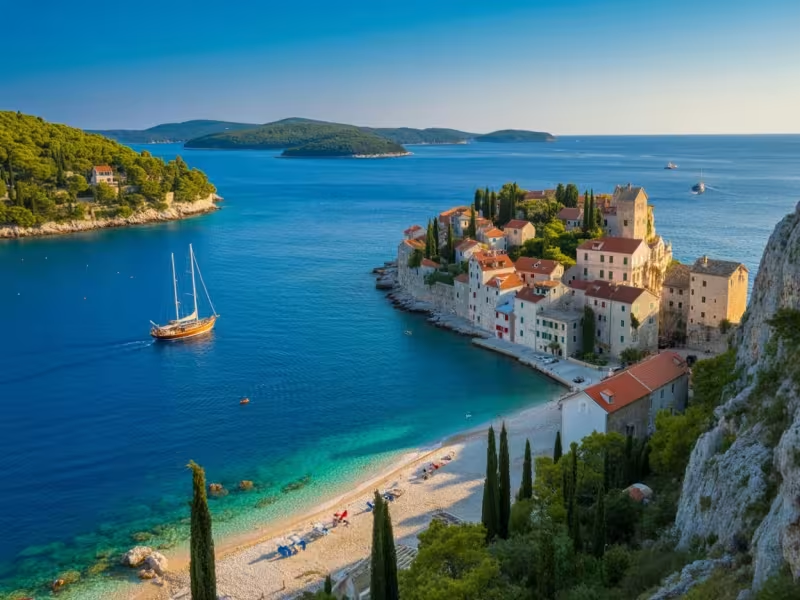
ADRIATIC COAST -- November 23, 2026 -- Bar, the Montenegrin port town with a historic Old Town, logged 457,614 overnight stays in collective accommodation from January through August 2026, about 14.5% more than a year earlier. By our calculation, that is roughly 58,000 extra nights. Official figures for smaller Adriatic towns in Montenegro, Croatia, Italy, Slovenia and Albania show that growth is uneven, and that some famous resorts are flat or shrinking.
Bar and Herceg Novi grew while Budva stalled and Kotor declined
Montenegro offers the most town-level data. Herceg Novi registered 666,889 overnight stays in the same period, up about 7.6%. That works out to roughly 620,000 a year earlier, or about 47,000 more nights. Herceg Novi still has around 209,000 more stays than Bar, although Bar is growing faster.
Tivat rose about 5.5% and Ulcinj about 3.4%. Budva, one of the region's best-known resorts, stayed almost unchanged, and Kotor recorded a decline in the same accommodation category.
Bar offers its Old Town, waterfront and nearby beaches. Herceg Novi has fortresses, historic streets and access to the Bay of Kotor.
Abruzzo's overnight stays rose about 21.4% to roughly 8.7 million in 2025
Regional statistics put tourist arrivals in Italy's Abruzzo up about 22.3% in 2025. Backing out the growth, the 2024 base was roughly 7.2 million overnight stays, so the region added about 1.5 million. The figures cover coastal and inland areas, so they do not isolate the seaside.
On the coast, Vasto sits near the Punta Aderci Nature Reserve. Ortona gives access to the Trabocchi Coast, and San Vito Chietino is known for its wooden fishing platforms, the trabocchi. Termoli (Molise), Sirolo (Marche) and Vieste (Puglia) are other smaller Italian Adriatic stops.
Croatia and Slovenia publish national totals, not town figures
Croatia recorded about 110.1 million tourist overnight stays in 2025, according to national tourism figures. Slovenia recorded more than 17.8 million, up about 6%, so Croatia's total is roughly six times Slovenia's. Slovenian seaside resorts grew about 3%, half the national pace.
In Croatia, Šibenik has the UNESCO-listed Cathedral of St. James and is close to Krka National Park. Trogir, also UNESCO-listed, is near Split Airport. Primošten, Korčula and Vis complete the list of smaller options. In Slovenia, Piran, Izola, Strunjan and Ankaran cover the short coast.
The release gives no town-level arrival figures for Croatia, Slovenia or Albania, and it says national growth does not prove each small town gained visitors.
The figures also cover different periods:
- Montenegro: overnight stays in collective accommodation, January to August 2026
- Albania: national visitors to accommodation establishments, August 2026
- Croatia, Slovenia and Abruzzo: full-year 2025
Albania's accommodation visitors rose 10.3% in August 2026, but the Riviera is not on the Adriatic
Albania's official statistics show visitors to accommodation establishments up 10.3% year over year in August 2026. That is a national number, not a coastal one. Vlorë is the gateway to southern Albania and the Karaburun Peninsula. Orikum has beaches, a marina and archaeological sites, and Zvërnec has lagoon scenery and a historic monastery.
Himarë and Dhërmi, often marketed as Albanian Riviera destinations, lie on the Ionian coast, not the Adriatic.
Neum is Bosnia and Herzegovina's main seaside destination, on a coastline shorter than Croatia's or Montenegro's.