National Civil Rights Museum

Civil Rights Museum Mourns Organizer Bernard Lafayette Jr.
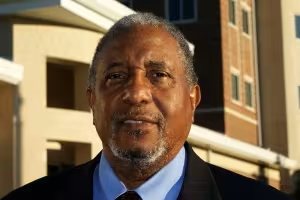
SHERIDAN, WYOMING -- August 18, 2026 -- The National Civil Rights Museum is mourning Rev. Dr. Bernard Lafayette, Jr., the organizer and nonviolence teacher who helped steer sit-ins, Freedom Rides, and the Selma campaign. Staff remember him as a 2012 Freedom Award honoree and a frequent visitor who walked students through the Lorraine Motel in Memphis. His death closes a living link to the people who planned the modern Civil Rights Movement from the ground up. For families still talking about voting rights at the kitchen table, his story shows how ordinary neighbors, trained and organized, changed national law. He spent a lifetime arguing that courage needed training, and that democracy grows when regular people learn how to stand up together.
Legacy Building Reopens as a Living Civil Rights Walk

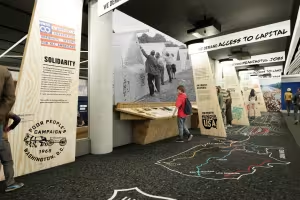
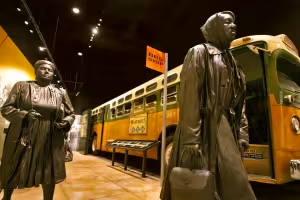
SHERIDAN, WYOMING -- August 18, 2026 -- Guests stepping into the National Civil Rights Museum’s Legacy Building this summer find more than fresh walls and new screens. The space reopened in late spring and now walks people through the work Dr. Martin Luther King Jr. left unfinished. Five galleries take on poverty, education, housing, gender, and nonviolence, the same pressures he named in his 1967 book Where Do We Go from Here: Chaos or Community? Families, students, and casual travelers can see how those issues still shape paychecks, classrooms, and neighborhoods. That connection turns a historic site into something people can use when they go back home.

Museum president Dr. Russ Wigginton framed the relaunch as an invitation into unfinished work, not a backward-looking shrine. The structure once faced the Lorraine Motel from the other side. Staff recast that wing as a place where the struggle continues in public view.

MLK Day at 40 Still Demands More Than a Day of Service

SHERIDAN, WYOMING -- August 18, 2026 -- Months after the country marked 40 years since the first Martin Luther King Jr. Holiday, the president of the National Civil Rights Museum asked Americans to look past familiar service projects and remember how hard that day was to win. Dr. Russ Wigginton wrote that Coretta Scott King spent 15 years building a coalition after the 1968 assassination at the Lorraine Motel, the site that now houses the museum. Lawmakers codified the holiday in 1983, and communities first observed it in 1986. That history still matters because a long weekend of food drives can soothe a conscience without touching voting rights, honest history in schools, and the economic inequality King named in his final campaign.

Why The Museum’s Farewell To Jesse Jackson Hits Home

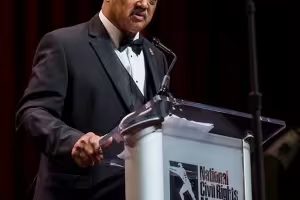
SHERIDAN, WYOMING -- August 18, 2026 -- The National Civil Rights Museum is mourning Reverend Jesse L. Jackson, Sr., the civil rights leader who stood with Dr. Martin Luther King, Jr. in the 1960s and later built groups that fought for jobs and votes. He began as a young leader in the Southern Christian Leadership Conference and as director of Operation Breadbasket, then founded Operation PUSH and the Rainbow Coalition. Those years were about breaking down racist systems and growing economic power in Black communities. The museum’s farewell matters to ordinary households because Jackson treated housing, health care, school access, and the right to cast a ballot as kitchen-table fights, not distant history.