NutraBrain

At-home ketamine therapy in Colorado starts at $425 by video

DENVER – November 14, 2026 -- At-home ketamine therapy in Colorado skips the clinic: by the company's own timeline, medication arrives roughly 8 to 12 days after you start, and every visit happens by video. NutraBrain, a telehealth provider, treats Colorado patients through Dr. David Mahjoubi, an anesthesiologist licensed in the state, with plans from $425.

The 8-to-12-day window is our calculation from the company's figures. Most patients finish intake and consultation within 3 to 5 days, and medication typically arrives 5 to 7 days after the consultation. A licensed U.S. compounding pharmacy fills the prescription within 1 to 3 business days and ships it by signature-required courier. The company says service and prices are the same in Denver, Grand Junction, Durango, Steamboat Springs and on the Eastern Plains.

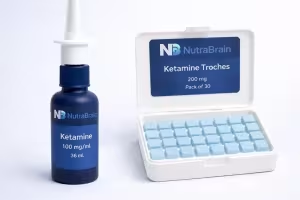
At-home ketamine: what dissociation feels like and how long it lasts

United States – November 14, 2026 -- An at-home ketamine session is meant to leave you feeling detached for roughly 30 to 90 minutes, and the prescribing clinic says you should not drive for 24 hours afterward. NutraBrain, which ships medication to patients in 15 states, has published a patient guide to this effect, called dissociation. Its program starts at $425 for a video consultation with Dr. David Mahjoubi plus the first month's prescription.

Most patients feel floating or distance that fades within 30 to 90 minutes, NutraBrain says

At the sub-anesthetic doses the clinic prescribes, it says people often report:

Spravato vs ketamine: what 8 clinic visits cost in month one

California – November 14, 2026 -- Spravato's first month means eight clinic visits and at least 16 hours of supervised observation, by our calculation from the dosing schedule. A comparison from the NutraBrain clinic and Dr. David Mahjoubi sets Spravato (esketamine) against compounded generic ketamine, which NutraBrain prescribes for home use from $349 a visit.

Spravato is the S enantiomer, one of the two mirror-image molecules in ketamine. The FDA approved it in March 2019 for treatment-resistant depression alongside an oral antidepressant. In 2020 it was also approved for depression with suicidal thoughts, and in January 2025 for use on its own. Ketamine was approved in 1970 as an anesthetic. Prescribing it for depression is off label, and compounded ketamine is not FDA approved.