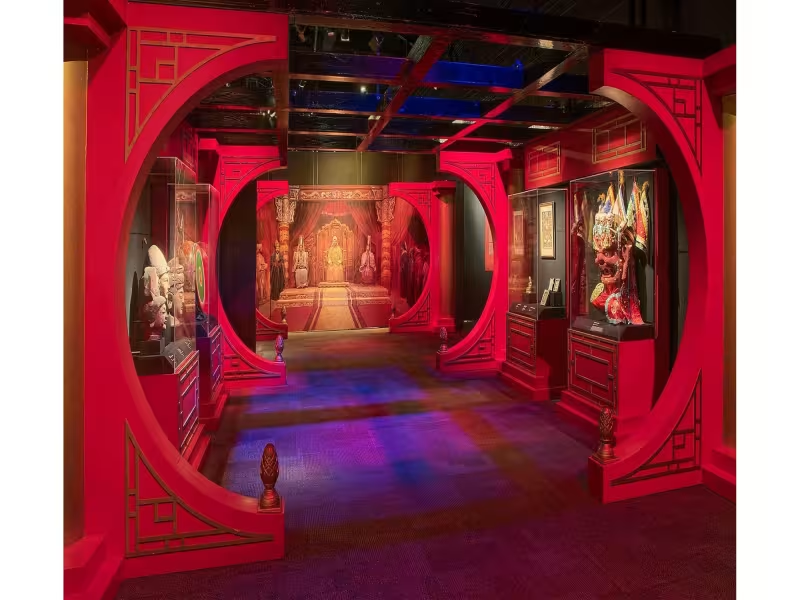
Union City, Tenn. – September 15, 2026 -- Discovery Park of America will open "Genghis Khan: Beyond the Empire," a 4,000-square-foot traveling exhibition, to the public on June 15, 2027, running through Sept. 7, 2027, with a members-and-media preview on June 14, 2027.
More than 300 artifacts will arrive in three 53-foot trucks
The exhibition requires nearly two weeks to install and includes swords, bows and arrows, armor, helmets, ceramics, religious objects, horse equipment and household items spanning centuries of Mongolian and Eurasian history. Notable pieces documented in the collection include a sword dating to approximately 1225, a Mongolian sword dated 1260, a recurved bow from about 1300, horseman's armor from about 1300 and a bronze firearm dated 1328.
Mongolian artists will perform live at the museum daily
Throughout the exhibition's run, artists in residence will present traditional instrumental music and throat singing, and will discuss their instruments, clothing and life in Mongolia directly with visitors. The exhibit also features full-scale environments, immersive projections, documentary films, interactive touch screens, role-playing experiences and a life-size open Mongolian ger.
The show traces Genghis Khan's empire from the steppe to the Silk Road
Visitors move from the grasslands of Mongolia and the rise of Genghis Khan's armies through the walled city of Karakorum and the Silk Road to the palace world of his grandson, Kublai Khan. Scott Williams, president and CEO of Discovery Park of America, said the exhibition gives guests a chance to experience Mongolian culture through art, music, traditions, objects and stories.
Leaders Credit Union is the premier sponsor of the exhibit
Leigh Anne Bentley, chief marketing officer at Leaders Credit Union, said the sponsorship reflects the credit union's commitment to making educational and cultural experiences available across West Tennessee. The exhibition was organized by author and Dino Don Inc. President Don Lessem, with curatorial input from Dr. William Fitzhugh of the Smithsonian Institution and Dr. Morris Rossabi of Columbia University, and developed in cooperation with Mongolia's Ministry of Education, Culture and Science in Ulaanbaatar.