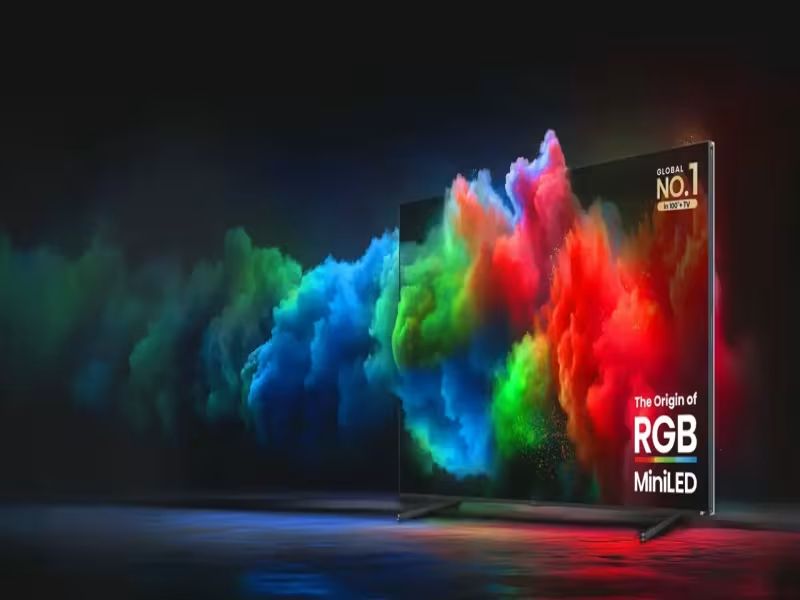
Alpharetta – October 12, 2026 -- Hisense now sells RGB MiniLED TVs in four series, from 55 to 116 inches, with up to 100% BT.2020 color coverage on most models and no burn-in risk.
Color is now made in the backlight
Traditional premium LCDs pair a white backlight with a quantum dot layer to build color. RGB Mini-LED drops that layer. Thousands of Mini-LEDs, each red, green, or blue, produce primary colors at the source. The LCD still uses a color filter, but it absorbs less energy because the light reaching each subpixel already matches its target color.
Each backlight element holds its own red, green, and blue Mini-LEDs and adjusts them independently. That gives every zone two controls, light and color, instead of the single brightness control in traditional Mini-LED.
A dedicated processor keeps backlight and panel in sync
The Hisense Hi-View AI Engine RGB processor analyzes each frame. It tells every backlight zone what color and luminance to use while also directing the LCD on pixel modulation and signal processing. Because zones match the color of the content above them, a bright blue star on a black sky produces an almost imperceptible dark blue halo rather than a gray or white glow.
What buyers get over standard Mini-LED and OLED
Hisense RGB MiniLED reaches up to 100% BT.2020 coverage, versus roughly 75% for most standard Mini-LED TVs. On a traditional Mini-LED, a bright yellow sunset can wash out to white at peak brightness; on RGB MiniLED the backlight produces warm amber light, so the color holds. The TVs support Dolby Vision IQ, HDR10+, and HLG.
The panels use inorganic LEDs, so there is no burn-in risk or organic material degradation, which matters for static elements like gaming interfaces or news tickers. Hisense also pitches the sets for bright rooms, noting that OLED depends on dark rooms for optimal performance.
The four series
116UX: 116-inch class, 8,000 nits peak brightness, 3,584 dimming zones, 20,000+ color control units, 100% BT.2020, 165Hz, Hi-View AI Engine X. It debuted at CES 2025.
116UXS: Announced at CES 2026, it adds cyan as a fourth primary. It has 43,000+ color dimming zones and up to 110% BT.2020 coverage.
UR9: Sizes of 65, 75, 85, and 100 inches, up to 5,500 nits, up to 100% BT.2020, native 180Hz (330Hz at 1080p), HDMI 2.1 plus DisplayPort inputs.
UR8: Sizes of 55, 65, 75, 85, and 100 inches, up to 3,800 nits, up to 100% BT.2020, Pantone certification, native 180Hz, four HDMI 2.1 ports, and Devialet audio.
All series run Google TV with Gemini Interactive AI.