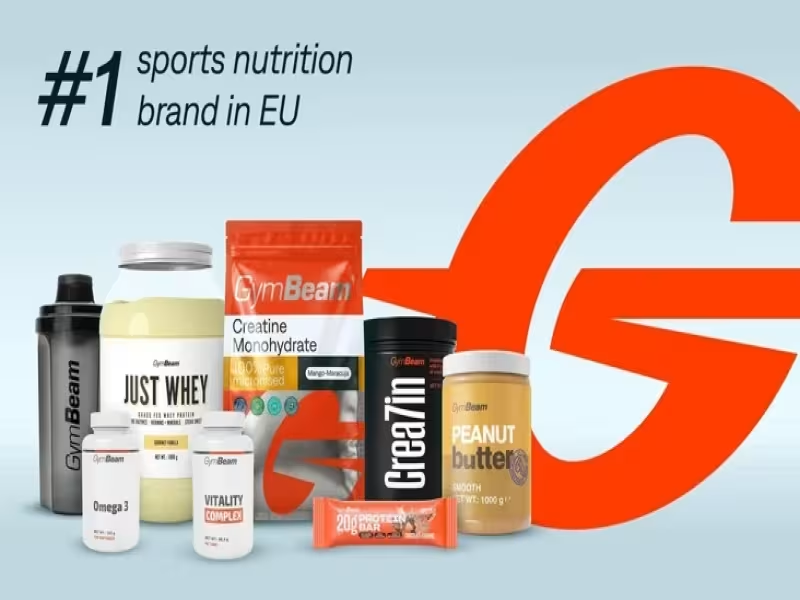
Kempen – November 01, 2026 -- Most people who train need only four supplements: whey protein, creatine monohydrate, vitamin D3 and omega-3. According to a GymBeam guide reviewed by food scientist Petr Loskot, these are the only standard-range products backed by either an approved EU health claim or an International Society of Sports Nutrition (ISSN) position paper. Everything else is fine-tuning.
Each of the four has a defined daily dose
Protein works at 20 to 40 g per portion, and creatine at 3 g daily. Vitamin D3 is set at 1,000 IU daily, and omega-3 (EPA and DHA) at 250 mg combined per day or more. Of several thousand health claims submitted to the European authority, roughly 260 were approved, and the full register is public.
On the label, check protein per 100 g rather than per portion, because manufacturers choose portion size freely. For vitamin D3, look at IU per capsule, since a daily serving can be several capsules. For omega-3, look at the stated EPA and DHA content, not the fish oil amount.
Trainees need 1.4 to 2.0 g of protein per kilogram of body weight
That is the ISSN recommendation (Jäger et al., 2017). At 80 kg, it comes to 112 to 160 g a day, spread across all meals rather than only the shake. Powder fills the gap: reaching 150 g through meat, eggs and quark means eating far more volume than with two whey servings.
Price per kilogram of protein beats price per kilogram of powder
The formula is price per kg of powder divided by protein content as a decimal. Two powders with the same kilo price differ by about 33% in cost per kilogram of protein if one contains 60% protein and the other 80%.
The guide's worked example is Just Whey Protein at €33.51 per kg with 74.9 g protein per 100 g. Dividing €33.51 by 0.749 gives €44.74 per kilogram of pure protein.
Creatine needs no loading phase
Taking 3 to 5 g of creatine monohydrate daily reaches the same saturation after about 28 days as a loading phase does. The loading variant, 20 g daily for 5 to 7 days, fills stores faster but not everyone tolerates it well in the stomach. Supplementation can raise creatine stores by 20 to 40%, from a baseline of 60 to 80% on a normal diet.
Creapure® costs 3.4 times more and adds provenance, not potency
Creapure® is a brand name for creatine monohydrate from German manufacturer AlzChem Trostberg, with a stated purity of 99.9%. GymBeam's standard micronised creatine costs €17.40 per kg and has a 4.8 rating from 7,775 reviews. The Creapure® version costs €59.80 per kg in a 250 g tin and has a 4.7 rating from 1,565 reviews.
Athletes in doping-controlled competition need the finished product itself listed in a doping-certification database. A certified raw material is not enough, and the listing should be checked in the public database, not on the packaging.
Four label checks separate tested products from marketing
Read the nutrition table on the back, check the ingredient list for fillers, look for a named raw-material supplier, and compare any claimed effect with the EU register. Production certificates such as IFS, GMP or HACCP cover manufacturing processes, while doping certifications cover only freedom from banned substances.