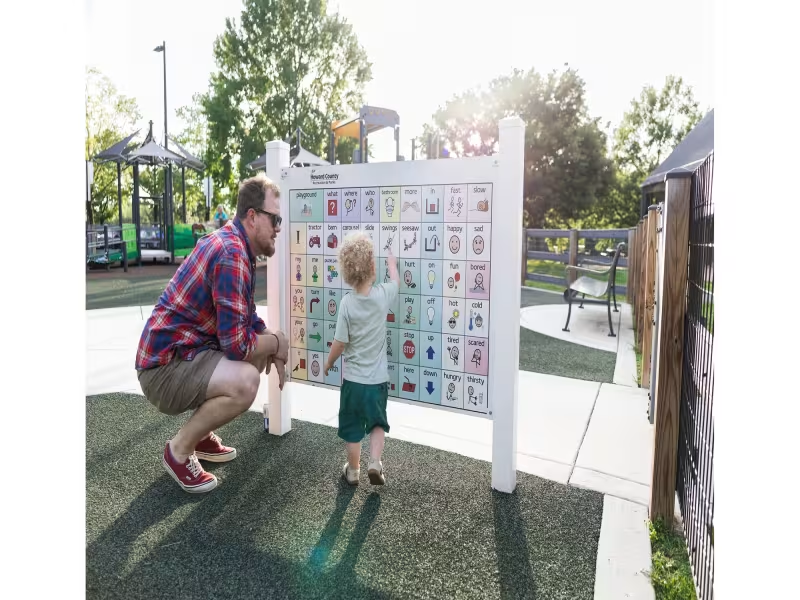
Rockville – October 01, 2026 -- More parks, libraries, and stadiums are installing large picture-based communication boards, and the American Speech-Language-Hearing Association (ASHA) is using October's AAC Awareness Month to explain why they matter.
Communication boards are a form of augmentative and alternative communication (AAC)—typically large displays showing a dozen or more common words like "slide," "go," "bathroom," or "play." They let people with limited or unreliable speech communicate with others in public spaces. In the United States, more than 2 million people use AAC, ranging from gestures and facial expressions to picture boards and high-tech speech-generating devices.
Public boards serve people beyond those who rely on AAC daily
Many AAC users already carry personal communication devices or boards, but large public versions help raise community awareness and give everyone practice using them. Portable boards also show up in places like stadiums and concert halls, serving as backup when a person's primary device is charging or when faster access to location-specific vocabulary is needed.
ASHA notes the boards can help young children who recognize pictures before they can verbalize requests, and adults who temporarily lose their voice and need to communicate an urgent need in public.
The boards are becoming more common as communities push for inclusion
AAC is used by people with a range of conditions, including apraxia of speech, aphasia, autism, cerebral palsy, developmental delays, and rare genetic conditions. ASHA 2026 President Linda I. Rosa-Lugo said public communication boards help bridge gaps in understanding between people with communication challenges and others in their communities, adding that successful interaction is a shared responsibility.
ASHA offers five tips for interacting with someone using a board
The association recommends pointing to words as you say them aloud, giving the person extra time to look at the board and make a selection, and staying consistent even when exchanges take longer than typical conversation. It also suggests standing to the side of the board so both parties can see the full display—taking a photo of it to reference while moving around a building or playground—and offering choices by pointing to words one at a time and watching for a response.