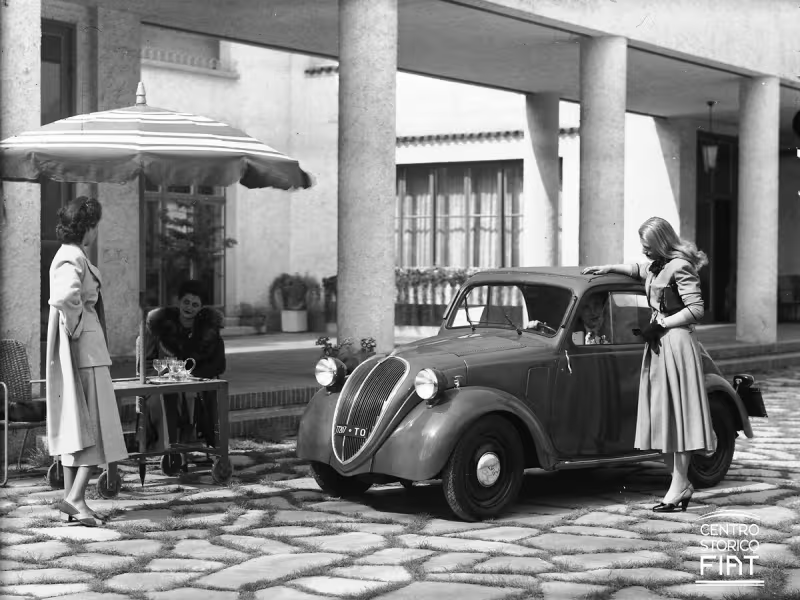
SHERIDAN, WYOMING -- June 15, 2026 -- Ninety years ago, a tiny car with a tapered hood and headlights that looked like mouse ears rolled out of Turin and quietly rewrote the rules of who could afford to drive. The Fiat 500 "Topolino" — launched in June 1936 — didn't just sell well; it launched the mass motorization of Italy and handed ordinary families the freedom of the road for the first time. To mark the milestone, the Topolino Autoclub Italia and Club Topolino Fiat Torino joined forces under a committee called "La Topolino va ai 90," staging a four-day rally from June 11 to 14 that wound through some of the most storied landmarks in and around Turin. More than 130 original examples participated, making it one of the most significant gatherings of classic Fiats in recent memory.
A Rally Through Piedmont's Most Iconic Backdrops
The convoy passed through a string of locations that felt almost purpose-built for the occasion: the Sacra di San Michele, the Reggia di Venaria, the Basilica of Superga, and the Castello di Rivoli. Each stop added a layer of visual drama to a car that was never exactly shy about making an impression. Small in size, enormous in personality — the Topolino has always had that quality, and the backdrop of Piedmont's palaces and abbeys only amplified it.
On Saturday, June 13, the crews made a special detour to the Heritage Hub inside the Mirafiori industrial complex — the same site where Topolino production was based from 1947 onward, after earlier years at the Lingotto factory. The stop became an exclusive event for rally participants, combining a guided tour of the heritage collection with a gala dinner held amid some of the most remarkable automobiles in Italian history.
What Was on Display at the Heritage Hub
The Heritage Hub had prepared something fitting for the occasion. Two examples of the B and C versions of the Fiat 500 Topolino anchored the display, flanked by reproductions of original advertising posters and artist sketches produced for the car's 1936 launch — works whose originals are preserved at the Centro Storico Fiat. A Fiat 500 A chassis, on loan from MAUTO, also featured prominently. FIAT gifted it to the museum in 1937, and it remains a remarkable object: visible proof of how Dante Giacosa's engineering drew on aeronautical techniques from his earlier career at Fiat Avio to squeeze maximum efficiency from minimal materials.
The Engineering Story Behind the Nickname
Giacosa inherited the project in 1934 after an earlier prototype ran into trouble. The original concept — a front-wheel-drive layout proposed by Technical Director Antonio Fessia — had to be abandoned, and Giacosa redesigned the car with a conventional front engine and rear-wheel drive. His solution, though, was anything but conventional: the 569 cc four-cylinder engine sat ahead of the front axle, even in front of the radiator, allowing for the distinctive tapered bonnet that gave the car its silhouette. The radiator, mounted high behind the engine, used the thermosiphon principle to circulate coolant without a water pump. Thirteen horsepower pushed the car to 85 km/h — enough for Italy's roads at the time.
The external headlights, positioned on the front fenders, happened to resemble the ears of a certain Disney mouse, and the nickname stuck. When the car was presented as the "new small great car for economy and work" in June 1936, it cost 8,900 lire — above the original 5,000-lire target — but still sold roughly 20,000 units annually until the war interrupted production.
Three Series, 376,000 Units, One Legacy
After the war, the Topolino kept evolving. The 500 B arrived at the 1948 Geneva Motor Show with a nearly 30% power increase, upgraded brakes, hydraulic shock absorbers, and the debut of the Giardiniera Belvedere — the first four-seater Topolino, with wooden trim borrowed from American station wagons. The 500 C followed in 1949, introducing recessed headlights, a horizontal grille, an aluminium cylinder head, and the first cabin heating system in a series-production Fiat. Production ended in 1955 after more than 376,000 units across all three series, and the car circulated well into the 1960s before passing the baton to the Fiat 600 and the Nuova 500.
FIAT has described the Topolino's approach — accessible, practical, built around real needs — as something the brand continues to pursue today.
Mini FAQ
Q: What does "Topolino" mean? A: It's Italian for "little mouse." The nickname came from the car's external headlights, which resembled the ears of Mickey Mouse.
Q: How many Topolinos were built in total? A: More than 376,000 units across three series (A, B, and C), produced from 1936 until 1955.
Q: Can the public visit the Heritage Hub in Turin? A: Yes — the Heritage Hub is open every day except Mondays. Weekdays offer self-guided tours; weekends feature guided tours. Tickets must be purchased online in advance.
Q: What happened to the Topolino's production legacy? A: From 1947 onward, it was built at the Mirafiori complex in Turin — the same site where the Heritage Hub is now located.
For tickets and visiting information for the Heritage Hub, go to Fiat.