SHERIDAN, WYOMING – June 24, 2026 – Yokohama Rubber has announced it will launch the BluEarth-AllSeason2, a brand-new all-season passenger car tire, across Europe in September 2026. Designed as the successor to the BluEarth-4S AW21, it comes in 74 sizes and covers premium cars, SUVs, and battery electric vehicles. For European drivers who deal with rain-slicked motorways in November and patchy snow in February — then dry summer highways a few months later — a single tire that genuinely handles all of it is a real proposition, not just marketing copy.
Why All-Season Tires Are Having a Moment in Europe
Europe's all-season tire market has been growing steadily, and it's not hard to see why. Swapping between summer and winter sets twice a year costs time and storage space, and in many parts of the continent the weather rarely gets extreme enough to demand a dedicated winter tire. Yokohama is clearly betting that more drivers will lean into the all-season option — and the BluEarth-AllSeason2 is its play to capture that shift.
The new tire is positioned as a strategic product under Yokohama's medium-term management plan, known internally as YX2026. The idea is to develop tires that respond to the specific conditions and habits of regional markets, rather than shipping a generic global product everywhere.
How AI Got Involved in Building This Tire
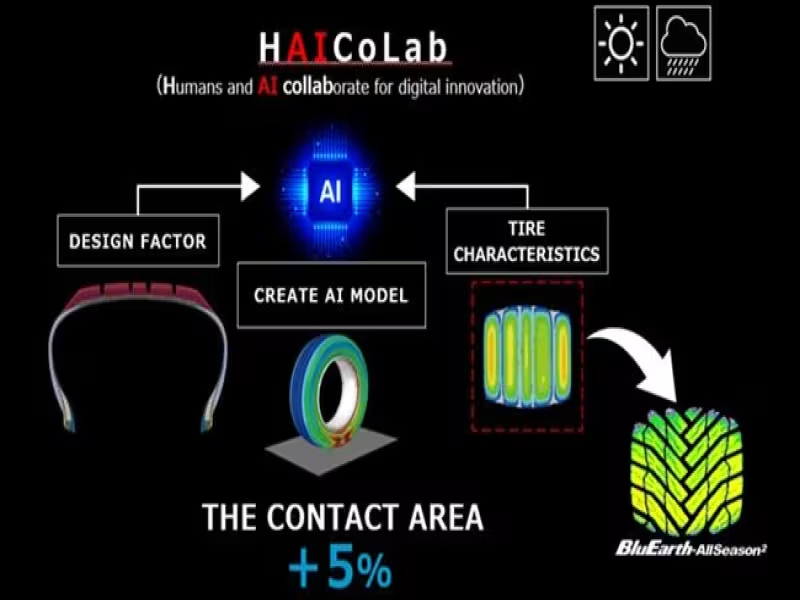
The BluEarth-AllSeason2 is the first Yokohama all-season tire developed with the company's HAICoLab framework — a system that combines human engineering expertise with AI modelling to refine tread patterns and structural characteristics before a prototype ever gets made. The practical result is a tread contact area that is 5% larger than the outgoing model, which translates to more stable handling and better grip across conditions.
It's also the first YOKOHAMA all-season product built using the company's COLD TECH technology concept, a development approach originally applied to dedicated winter tires. COLD TECH focuses on compounds, tread structures, and patterns that maximize contact with winter road surfaces — the idea being to give the BluEarth-AllSeason2 meaningfully better snow performance than a typical all-season tire.
The Technical Details That Actually Matter
The tread pattern uses symmetrical V-shaped grooves, which push water out efficiently and help maintain stability on wet roads while preserving edge grip on snow. Crank sipes and 3D sipes are placed to reinforce that snow grip and reduce block deformation under acceleration and cornering.
On the compound side, Yokohama used its A.R.T. Mixing technology to disperse a large amount of silica more evenly through the rubber. The result, according to the company, is a 40% increase in the compound's contact points on wet surfaces — which feeds directly into wet grip performance.
Rolling resistance drops by 8% compared to the previous model, helped by lightweight steel belts in the tire structure. That matters for fuel efficiency in combustion cars and range in EVs. Wear resistance goes up by 35%, which over the course of a tire's life is a meaningful difference in how long it actually lasts.
Mini FAQ
Q: When does the BluEarth-AllSeason2 go on sale in Europe? A: September 2026.
Q: What vehicles is it designed for? A: Premium passenger cars, SUVs, and battery electric vehicles. It will be available in 74 sizes.
Q: What's different from the previous model? A: Larger contact patch (+5%), improved wet grip through better silica dispersion (+40% contact points on wet surfaces), lower rolling resistance (-8%), and significantly higher wear resistance (+35%).
Q: Does it work in snow? A: Yes — it was the first YOKOHAMA all-season tire developed using the COLD TECH winter technology concept, specifically targeting more stable surface contact on snow.