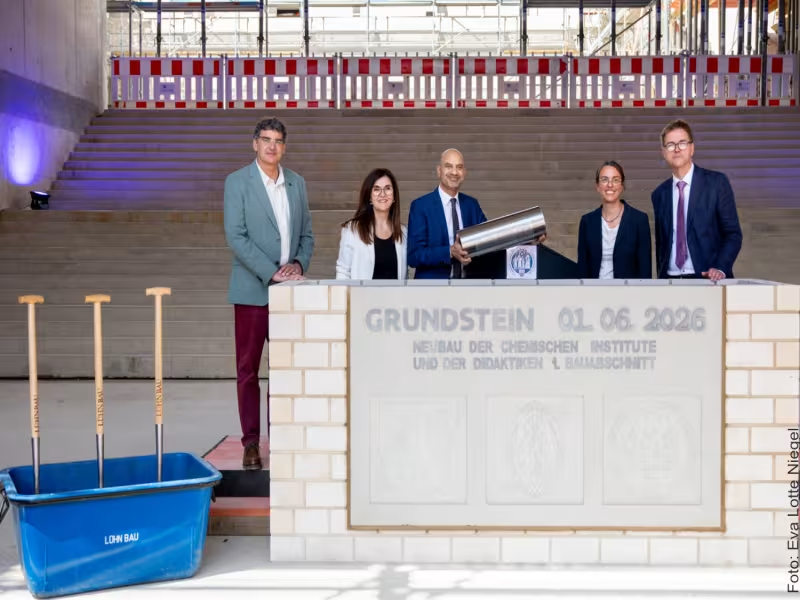
SHERIDAN, WYOMING -- June 2, 2026 -- The University of Cologne has officially broken ground on a sweeping new chemistry campus that will reshape research and teaching at one of Germany's most prominent universities, laying the foundation stone on June 1 for new buildings dedicated to Chemistry, Biochemistry, and Science Education at the corner of Luxemburger Strasse and Greinstrasse in Cologne. With a total approved floor space of around 25,800 square metres -- nearly four football pitches -- and a budget of close to €400 million, this is one of the largest university construction projects in the entire state of North Rhine-Westphalia. The project, scheduled for completion in 2034, promises to bring world-class laboratory facilities, modern workspaces, and a genuinely connected scientific community under one roof for the first time.
A Ceremonial Moment with a Long View
The groundbreaking ceremony brought together some of Cologne's most senior academic and civic figures, including the university's rector, the city's deputy mayor, the university chancellor, the dean of the Faculty of Mathematics and Natural Sciences, and the director of the Department of Chemistry and Biochemistry. Together they filled a time capsule with documents and objects before sealing it into the foundation stone, which was embedded beneath the entrance foyer area on Greinstrasse. A floor plate bearing the date of the ceremony will mark the spot permanently -- a small but meaningful gesture connecting the building's future occupants to the moment it all began.
Why Bringing Everything Together Matters
For years, chemistry and biochemistry functions at the University of Cologne have been spread across older buildings with limited space and aging infrastructure. The new development is designed to fix that by consolidating the Department of Chemistry and Biochemistry alongside the Mathematics and Natural Science Education departments onto a single, purpose-built site. The logic is straightforward: when researchers share spaces, equipment, and ideas in close proximity, science moves faster and costs less. Expensive laboratory equipment that would otherwise be duplicated across multiple sites can now be shared, reducing strain on both budgets and energy consumption.
The project also follows the recent completion of a new physics building on the same southern campus, suggesting the university is executing a longer-term vision to modernise its entire natural sciences infrastructure piece by piece.
A Hub for the Next Generation of Scientists
Beyond the practical benefits, the new chemistry campus is being conceived as a genuine meeting place -- somewhere students and researchers will actually want to spend time. The director of the Department of Chemistry and Biochemistry pointed to the strong momentum already building within Cologne's chemistry community, including DFG-funded research training groups and the Humboldt Centre for Nano- and Biophotonics, as signs that the new infrastructure is arriving at exactly the right moment. The idea is for cutting-edge research and the education of the next generation of scientists to happen side by side, feeding into each other in ways that a fragmented campus simply cannot support.
The dean of the Faculty of Mathematics and Natural Sciences highlighted the potential for the new building to become a genuine centre of exchange -- one that benefits not just the academic community but also industry and wider society through faster knowledge transfer.
What It Means for Cologne as a Science City
Projects of this scale don't just change a campus -- they change a city's identity. Cologne is already a significant European centre for science, business, and culture, and an investment of nearly €400 million in research infrastructure sends a clear signal about the direction of travel. The deputy mayor of Cologne framed the groundbreaking as a meaningful investment in the city's future, strengthening both research capacity and Cologne's long-term reputation as a place where serious science happens.
For students considering where to study chemistry or biochemistry, a brand-new, purpose-built campus with modern labs and collaborative spaces is a compelling reason to look at Cologne. For researchers, the promise of consolidated infrastructure and reduced administrative friction makes it an increasingly attractive destination.
Mini FAQ: University of Cologne New Chemistry Campus
Q: When will the new chemistry buildings be completed? A: The project will be delivered in multiple phases, with completion expected by 2034.
Q: How big is the new development? A: The approved total floor area is around 25,800 square metres -- roughly equivalent to four football pitches.
Q: How much does the project cost? A: The budget is close to €400 million, making it one of the largest university construction projects in the state of North Rhine-Westphalia.
Q: What will the buildings house? A: The new campus will consolidate the Department of Chemistry and Biochemistry and the Mathematics and Natural Science Education departments in one location, sharing laboratory equipment and research infrastructure.