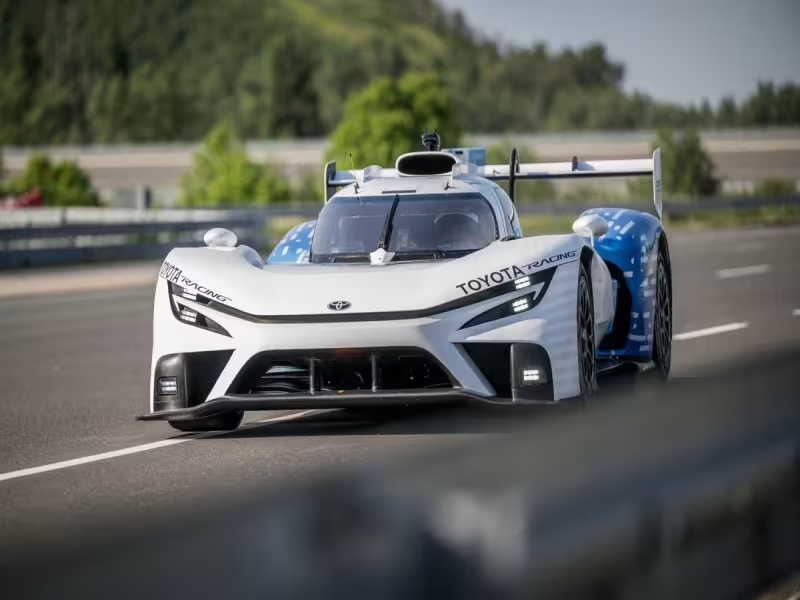
SHERIDAN, WYOMING -- June 6, 2026 -- Toyota Racing is set to make motorsport history at the Circuit de la Sarthe next week, conducting the first-ever public demonstration drives of its liquid hydrogen-fuelled TR LH2 Racing Prototype during the 94th edition of the Le Mans 24 Hours. Built on the same chassis as the TR010 HYBRID Hypercar competing in the race itself, the TR LH2 Racing Prototype represents years of hydrogen technology development pushed forward through real-world motorsport competition — and next week, fans at Le Mans will hear and experience a hydrogen combustion engine at full noise on one of the world's most iconic circuits for the very first time.
When and Where to See It
The TR LH2 Racing Prototype will complete demonstration laps of the 13.626 km Circuit de la Sarthe on two occasions: Thursday 11 June at 12.50pm and Saturday 13 June at 12.45pm. Both runs coincide with the build-up to and opening of the Le Mans 24 Hours race itself, which takes place on 13–14 June, giving fans the rare opportunity to witness hydrogen-powered racing alongside the main event.
Before hitting the track, the prototype will be on display in the Hydrogen Village — an exhibition of hydrogen technology that opened on Wednesday 10 June, showcasing vehicles and information centred on Toyota's commitment to a carbon-neutral future.
A Prototype Built on a Race-Proven Chassis
The TR LH2 Racing Prototype does not start from a blank sheet. It shares its chassis with the TR010 HYBRID Hypercar, the car Toyota is fielding in the Le Mans 24 Hours race proper. Using an active race platform as the foundation for hydrogen development is a deliberate choice — it means the technology is being stress-tested against the demands of genuine top-level competition rather than in isolation, accelerating the pace of learning and raising the ceiling on what hydrogen power can achieve.
Years of Development Leading to This Moment
Toyota's hydrogen journey in motorsport stretches back further than many fans may realise. The programme began with Rookie Racing's participation in the Japanese Super Taikyu series using the ORC ROOKIE GR Corolla H2 Concept, initially running on gaseous hydrogen from 2021 before transitioning to liquid hydrogen power in 2023. The potential of hydrogen in rally competition was demonstrated in 2022 when a GR Yaris H2 completed runs on the Ypres Rally, a round of the FIA World Rally Championship, with further demonstrations following at the 2025 Rally Finland and this year's Rallye Monte-Carlo.
At Le Mans specifically, a hydrogen demonstration lap of the Circuit de la Sarthe was completed in 2023 using the ORC ROOKIE GR Corolla H2 Concept, alongside the unveiling of the GR H2 Racing Concept as a preview of a potential future hydrogen category. Last year brought the reveal of the liquid hydrogen-powered GR LH2 Racing Concept at the same venue. Each step has built on the last, and next week's public demonstration laps represent the most significant milestone yet.
Why This Matters Beyond the Track
Hydrogen combustion technology sits at the heart of a broader debate about what carbon-neutral motorsport could look like in the future. Toyota's approach — using the pressure and exposure of real racing and high-profile events to develop and validate the technology — is a calculated bet that motorsport can serve as a genuine proving ground for solutions that eventually matter on public roads. Bringing the TR LH2 Racing Prototype to Le Mans, in front of hundreds of thousands of fans, is as much about building awareness and appetite for hydrogen as it is about lap times.
3 Reasons This Le Mans Demonstration Matters
- It marks the first time a liquid hydrogen racing prototype has completed public demonstration laps at any circuit, making Le Mans 2026 a genuine landmark moment for the technology.
- The shared chassis with the TR010 HYBRID Hypercar means hydrogen development is happening at the highest level of endurance racing, not in a separate silo.
- The Hydrogen Village gives fans direct access to Toyota's wider hydrogen ecosystem, from road cars to race machinery, in one place at one of motorsport's biggest stages.