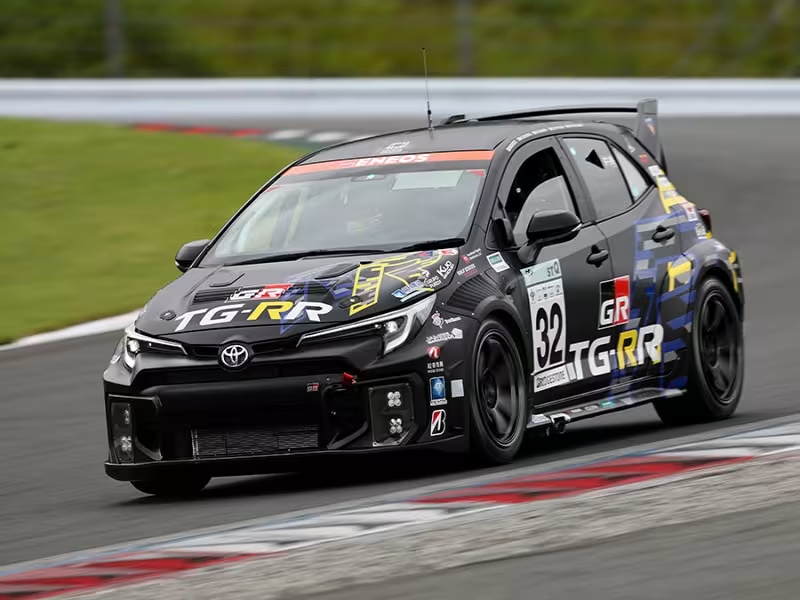
SHERIDAN, WYOMING -- June 6, 2026 -- Toyota has taken another significant step in its hydrogen motorsport programme, entering the #32 TGRR GR Corolla H2 concept in the NAPAC Fuji 24 Hours Race on June 5 and 6 at Fuji Speedway — and doing so with a genuine world first under the bonnet. The liquid hydrogen-powered GR Corolla is the first race car ever to compete equipped with a superconducting liquid hydrogen pump, a technology unveiled only at the final round of the 2025 Super Taikyu Series. For anyone who cares about where motorsport and clean energy are heading, this is one of the most technically significant races happening anywhere in the world right now.
What Makes the Superconducting Pump a Big Deal
To understand why this matters, it helps to know how the liquid hydrogen system works. When hydrogen is fed from the fuel tank to the engine, it is first compressed by a pump before being transported. On previous versions of the GR Corolla H2, that pump was driven by a conventional electric motor mounted on top of the tank. For the Fuji 24 Hours, that motor has been replaced with a superconducting motor — a technology that only becomes possible at the ultra-low temperatures of liquid hydrogen, which sits at -253°C.
The change is not just a technical curiosity. Relocating the entire motor unit inside the tank freed up space that previously housed the motor on top, allowing the tank capacity to grow from 220 litres at the 2025 season finale to a maximum of 300 litres — an increase of more than 1.3 times. Moving a heavy component lower inside the car also lowers the centre of gravity, which is expected to bring measurable improvements to how the car handles on track. Racing under the harsh conditions of a 24-hour endurance event will now put the pump's performance and durability to its most demanding test yet.
A New Transmission Pairing for Hydrogen Power
The superconducting pump is not the only world first at Fuji. For this race, Toyota has paired a hydrogen engine with its Direct Automatic Transmission — DAT — for the first time ever. DAT was developed with a specific goal in mind: to create an automatic transmission capable of competing on equal terms with a manual gearbox, targeting some of the world's fastest shift speeds while removing the cognitive load of gear changes from the driver.
The combination of hydrogen combustion and DAT opens up new possibilities for who can drive hydrogen-powered race cars, which has broader implications for how Toyota envisions hydrogen technology being adopted — not just by skilled manual transmission drivers, but across a wider base of motorsport participants and eventually road car users.
A Long Road to This Point
The GR Corolla H2 programme has been building steadily since Toyota first entered a hydrogen-powered car in the Super Taikyu Series in 2021, initially running on gaseous hydrogen. The shift to liquid hydrogen came in 2023, unlocking higher energy density and enabling the longer, more sustained running that endurance racing demands. Each season has introduced new development targets — combustion efficiency, pump durability, fast refuelling — and each race has served as a real-world validation environment that no laboratory can fully replicate.
The Fuji 24 Hours is the third round of the 2026 ENEOS Super Taikyu Series Empowered by Bridgestone, and it represents the most technically advanced configuration the hydrogen GR Corolla has ever raced in.
3 Reasons This Race Matters
- The superconducting liquid hydrogen pump is a genuine world first in competition, not just in a laboratory — endurance racing will now prove whether it works under sustained real-world stress.
- Tank capacity growing from 220L to 300L means less time refuelling and more time demonstrating the usable range of liquid hydrogen power in a race environment.
- Pairing DAT with a hydrogen engine for the first time broadens the potential driver base for hydrogen motorsport and accelerates transmission technology development simultaneously.
Follow the live coverage of the Fuji 24 Hours race and Toyota's hydrogen programme at Motorsports 2026.