Money & Finance

Cash or Card Abroad? What 1,500 Travelers Say About Paying
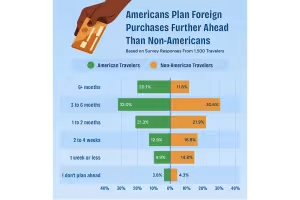
Austin – October 29, 2026 -- Most international travelers still pack both cash and plastic: 71% use local-currency cash abroad and 69% use a physical credit card, according to a new Upgraded Points survey of 1,500 adults who traveled internationally in the past 12 months.

The respondents included 1,000 U.S. adults and 500 adults from other countries. They answered questions about payment methods, cash habits, credit card use, airport currency exchanges and confidence with exchange rates.

Cash in the local currency is still in most wallets

More than 8 in 10 travelers (81%) carry cash in their destination's currency. Of those, 64% use it at street vendors, markets or small businesses, 55% use it for tips and other customary cash payments, and 53% keep it for emergencies.

Few people load up on it at once. About 44% exchange enough cash for several days, while 26% exchange enough for the full trip.


Laid Off at 40+? How Managers Can Restart Their Careers

Frankfurt am Main – October 28, 2026 -- Managers who lose their jobs at 40 or 50 don't have to start from zero, according to career adviser Dr. Hans-Peter Luippold, who says the key is repositioning existing experience for a changed job market.

Companies such as Volkswagen and Bayer have been cutting management positions for months. For executives with 15 or 20 successful years behind them, that can mean a sudden restart.

Job loss often shakes professional identity

For longtime managers, a dismissal frequently means more than lost income. Familiar structures, responsibility and professional recognition disappear. Many also haven't written a job application in years, because they got their previous roles through promotions or personal contacts, so standardized rejections can be especially unsettling.

Home Equity Loan vs. HELOC: How Each Pays Out and Gets Repaid

Leavenworth, Kansas – October 28, 2026 -- Homeowners weighing a home equity loan against a home equity line of credit (HELOC) face one core choice: take the money all at once or draw it as needed. A new HelloNation article compares how each product delivers and repays funds.

A home equity loan pays out once, at closing

Both tools let homeowners borrow against built-up equity. The difference is how the money arrives and how it is paid back. A home equity loan provides a single lump sum at closing. Repayment follows a set term, usually with a fixed interest rate and a predictable monthly payment.

eprimo Energy Week: Every 10th Contract Wins Free kWh

Neu-Isenburg – October 27, 2026 -- Anyone who signs a green electricity or natural gas contract on eprimo.de from October 27, 2026 has a chance to win free energy: every tenth successful contract gets either 300 free kWh of electricity or 2,000 free kWh of gas.

The prize covers about one month of use in most German households

According to eprimo, the free kWh are enough for an average German household for a full month. That works out to roughly one twelfth of an annual bill, returned as a credit.

Existing customers can enter too

Customers who already receive green electricity or gas from eprimo can still take part, because every additional new contract counts. All tariffs concluded on the eprimo website during the promotion period go into the prize draw.

How to Pick a Checking Account That Fits Your Daily Habits

Hattiesburg – October 27, 2026 -- Choosing the right checking account starts with how you handle money day to day, according to banking expert Jayda Moore of PriorityOne Bank, who shared her advice in a HelloNation article.

Basic services look similar across many accounts, but the features vary widely. Some customers want digital convenience, others want low costs or rewards.

Mobile tools cut down on branch visits

Online banking lets customers check balances, transfer funds, pay bills and monitor transactions without going to a branch. Mobile apps add balance alerts, debit card management and account activity reviews. Many banks also offer mobile deposit, which lets you deposit a check by photographing it in the app.

Midland, Michigan Tops U.S. News' Best Places to Retire Again

Washington – October 27, 2026 -- Midland, Michigan, is the No. 1 place to retire in the United States for the second year running, according to the 2027 Best Places to Retire list from U.S. News & World Report. Affordability was the deciding theme of this year's ranking.

Midland scores high on affordability and retiree taxes

Midland kept its top spot thanks to strong marks for affordability and retiree taxes. Homosassa Springs, Florida, placed No. 2 on affordability, growth in its 55+ population and retiree taxes. Weirton, West Virginia, took No. 3 with high scores for quality of life, retiree taxes and affordability.

New scoring weights push Paducah into the top 10

U.S. News adjusted its scoring weights to reflect growing concern about affordability in America. The change produced several double-digit jumps within the top 25. Paducah, Kentucky, climbed to No. 8 and entered the top 10 for the first time.

Veterans: Your State May Owe You Benefits Beyond the VA Check

United States – October 27, 2026 -- Veterans with a federal VA rating can often add state property tax exemptions, income tax breaks, tuition waivers for dependents and housing help, but almost none of it is automatic. Most state benefits require a separate application, and the rules differ widely from state to state.

Federal compensation is only the floor

According to VetsForever, a veteran-founded organization, each state runs its own rules and deadlines on top of the federal baseline. Depending on where you live, that can include:

How the VA's 5-, 10- and 20-Year Rules Protect Your Disability Rating

United States – October 27, 2026 -- Veterans who have held a VA disability rating for years have federal protection against cuts, and that protection gets stronger the longer the rating has been in place. Three regulations, 38 C.F.R. § 3.344, § 3.957 and § 3.951(b), set the 5-year, 10-year and 20-year rules. Trinidad Aguirre, CEO and co-founder of VetsForever, explains them on the Beyond the Rating series.

After five years, one good exam can't cut your rating

Under § 3.344, a rating in place for five years or more can't be reduced based on a single good exam. The VA needs sustained, documented improvement across more than one exam, judged under the ordinary conditions of daily life.

The VA can still schedule reexaminations on a protected rating, and a re-exam notice is not a reduction notice. Skipping the exam or going in unprepared can turn that appointment into the first data point in a reduction case.

Your VA Rating Rests on a File You've Probably Never Read

United States – October 27, 2026 -- Veterans can request a full copy of their VA claims file with one form, and a line-by-line read of it often shows where a denial went wrong, according to VetsForever, an organization that provides VA-accredited representation.

The VA rates only what sits in your file

The claims file, or C-file, is the VA's complete record on a veteran. It runs hundreds of pages, sometimes thousands, and holds every rating decision, Compensation and Pension (C&P) exam, service treatment record, private medical record, nexus letter, internal VA note and the full history of what was claimed and when.

A rater sets your percentage from that file alone. Under 38 C.F.R. § 3.159, the VA has a duty to assist with developing a claim and gathering relevant evidence. Still, it rates what is in front of it, so anything missing, recorded wrong or never developed shows up as a gap in the rating.

Canadian Banking Case Studies: Fees, Fraud and Fine Print

Canada – October 24, 2026 -- A set of Canadian banking case studies shows how mortgage insurance premiums, 0% balance transfer offers and card disputes can raise costs for ordinary customers.

Homebuyers and balance transfers face extra costs

Mr. and Ms. D put down less than 20% of the purchase price, so Canadian mortgage rules required an insured mortgage. The bank arranged the insurance. Their case centres on late disclosure of a higher premium, which added costs for the couple and ended in a low settlement.

Ms. J called her bank about a promotion offering 0% interest for 12 months on balances transferred from other cards. The bank confirmed the offer and a 3% transfer fee. Missed payments later increased her interest costs.

Ms. W always paid her cashback card in full. The 0% offer would have saved her money compared with the usual 20.99% on balances and 21.99% on cash advances. She later challenged the interest charges she received.